Western Europe’s Crypto Economy Reaches $2.08T as Stablecoin Holdings Surge 131%
Artigo sindicado de Bitcoinist. · Artigo original ↗
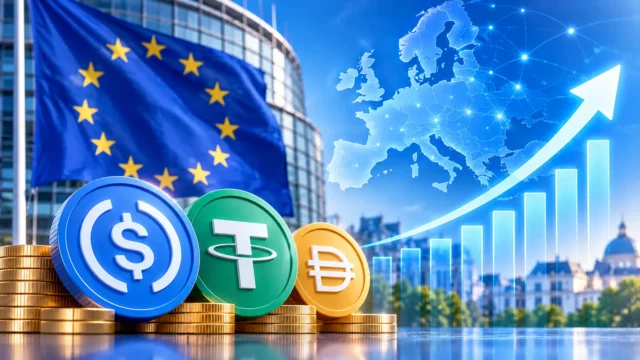
Western Europe’s crypto economy continued to expand despite a broader global market downturn, reaching $2.08 trillion in annual transaction activity as stablecoin adoption accelerated across the region.
A report published by blockchain analytics firm Chainalysis on November 9 found that crypto activity increased 1.2% between July 2025 and June 2026. This made Western Europe the world’s second-largest regional crypto economy and placed it among only three regions to record positive growth during the period.
Stablecoins were one of the strongest areas of expansion. Holdings in personal wallets across Western Europe climbed 131%, significantly outperforming the global growth rate of 52%. However, the figures also revealed contrasting trends among major markets, with the UK retaining its position as Europe’s largest crypto economy despite an annual decline in overall activity.
UK Remains Western Europe’s Largest Crypto Market Despite Contraction
The UK accounted for the largest share of Western Europe’s cryptocurrency activity, recording approximately $424.5 billion in transaction value during the reporting period. Nevertheless, activity declined 8% year over year, with reduced decentralized exchange trading contributing to the slowdown.
Germany ranked second with $288.8 billion, followed by France at $215.8 billion and the Netherlands at $207.8 billion. Spain and Switzerland recorded $156.1 billion and $132.8 billion, respectively.
Together, these six countries represented roughly two-thirds of the region’s total crypto economy, highlighting how heavily activity remains concentrated in Western Europe’s largest financial markets.
Stablecoin Holdings Outpace Global Growth
Stablecoins emerged as one of the most significant drivers of Western Europe’s crypto expansion. Personal-wallet holdings increased by 131% over the 12-month reporting period, compared with 52% growth worldwide.
The region’s share of global stablecoin balances consequently increased from 3.4% to 5.1%. Austria and France recorded particularly strong gains, while the broader trend suggests that stablecoins are becoming more important to how Europeans store and move digital assets.
Regulatory developments are also shaping the market. The European Union’s Markets in Crypto-Assets Regulation (MiCA) has established a common framework for crypto-asset issuers and service providers, creating clearer requirements for businesses operating across the bloc.